The Real Cost of Backyard Eggs
And Why the Feed Label Matters
When I posted on our local Facebook page that I have organic, soy-free, pastured fertile eggs for sale at $6.75 a dozen, most of my neighbors responded warmly. A few pushed back pretty hard, claiming they sell the same quality egg for $5 — and even turn a profit at that price. I want to address this honestly, because food transparency is something I care deeply about. What is real cost of backyard eggs?
But first, let me introduce you to Judas.
Judas came to us the way roosters usually do around here — as that one “free exotic chick” the hatchery slips into your order whether you asked for it or not. I always forget to tell them not to. It always turns out to be a rooster. It usually ends badly for the rooster.
Judas survived because he was raised alongside a kitten, and the two of them came up together without incident — genuinely sweet, actually. Then Judas hit maturity and pecked that kitten directly between the eyes. He has never understood why the cat doesn’t trust him anymore. Judas is, in many ways, a mystery to himself.
Judas is a Giant Black Cochin — one of the largest and most visually dramatic chicken breeds, with glossy black feathering all the way down his legs to his feet and a disposition that is, frankly, better than some people I’ve met. He is remarkably gentle with both his hens and his people, as long as you are not directly threatening the ladies. He also has 39 hens, which seems to be keeping him sufficiently occupied and reasonably cheerful. The cat remains unconvinced, but the rest of us have made our peace with him.
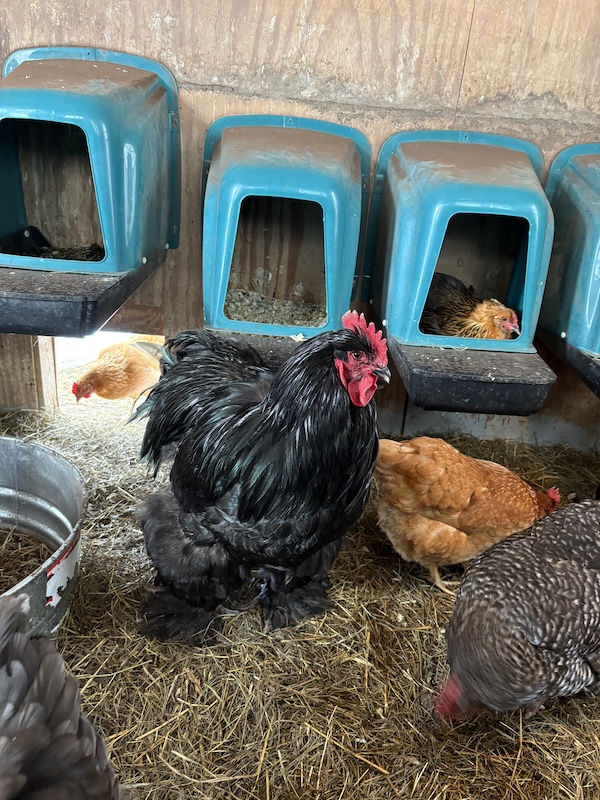
Now — an honest note about fertility, because I believe in giving you accurate information. The recommended ratio for reliable egg fertilization is roughly one rooster per 8 to 12 hens. Judas is presiding over 39, which is an ambitious arrangement even by rooster standards. Hens can store sperm for up to two to three weeks, so fertilization does happen across the flock — but realistically at a 1:39 ratio, we’re probably looking at somewhere around 50-70% of eggs being fertile at any given time, not 100%. Judas is doing his considerable best, and being a Giant Black Cochin he is eating closer to a third of a pound of feed per day rather than the standard quarter pound. I mention this because it matters for the math we’re about to do.
I Thought I Was Already Doing Things Right
Until recently I was using Poulin Grain Organic Layer from Vermont. It’s a local-ish feed with a largely respectable ingredient list, and I felt good about it. Then I sat down and actually compared the full ingredient labels across the brands I was considering, and I learned something that changed my mind — and my feed order. This is one of the things I love about doing the research: even when you think you’ve already made a good decision, there is often something better available if you’re willing to look.
Let me walk you through what I found, because I think it matters to you as the person eating these eggs — And your health is part of real cost of backyard eggs.
Reading Three Ingredient Labels
Poulin Grain Organic lists organic corn as its first ingredient, followed by wheat middlings, alfalfa meal, and ground wheat. There’s a lot that’s good here. But buried in the list is organic rapeseed meal — rapeseed being the plant that canola oil comes from, with all the controversy that follows it. There are also no probiotics in this formula, no flaxseed, and the mineral forms used (manganous oxide, zinc oxide) are less bioavailable than what better feeds provide. I have been providing my flock with probiotics and herbs through the winter.
Cluck & Co Organic from Tractor Supply — and I want to be very clear this is a completely different product from New Country Organics, whatever the packaging might suggest — opens with organic corn and organic canola meal as its second ingredient. Canola is simply the marketing name for a variety of rapeseed, so this feed leads with two of the more controversial ingredients in poultry nutrition back to back. It contains a single probiotic strain and a minimal overall formula.
New Country Organics Corn & Soy Free is in a different category entirely. And it comes as a loose mix of seeds and herbs, not a pellet. The first ingredient is organic field peas — a clean, digestible protein source with no baggage. Then organic barley, oats, wheat, fish meal, and organic flaxseed. No corn. No soy. No canola or rapeseed anywhere on the label. And at the end of the ingredient list, something that genuinely impressed me: seven strains of beneficial microorganisms, including Lactobacillus acidophilus, L. casei, L. plantarum, Bacillus subtilis, B. licheniformis, Enterococcus faecium, and Aspergillus oryzae fermentation extract. That is a serious gut health protocol — for the chicken.
This is what I am now using, and what I will continue to use.
Does the Feed Actually Affect the Egg You Eat?
Yes. Meaningfully. And it’s part of real cost of backyard eggs.
Omega-3 fatty acids:
Hens fed flaxseed produce eggs with significantly higher omega-3 content. Hens fed primarily corn — as in two of the three feeds above — produce eggs with a much heavier omega-6 load. The ratio of omega-6 to omega-3 in your diet is one of the most important factors in systemic inflammation. You are eating a different egg depending on what that hen was fed. This is not marketing language. It is basic biochemistry.
Soy and phytoestrogens:
Soy contains isoflavones that have estrogenic activity in the body. These compounds pass into egg yolks to a measurable degree. For women managing hormone balance, thyroid conditions, or autoimmune issues — which describes a significant portion of the women I serve both here and in my practice — this is not a trivial concern.
Flaxseed:
You may have heard that flaxseed — which is in New Country Organics — also contains phytoestrogens. That’s true, and it’s worth addressing directly. Flaxseed contains lignans, which are a different class of phytoestrogen than the isoflavones found in soy, and they behave very differently in the body. Rather than stimulating estrogen receptors the way soy isoflavones do, lignans appear to shift estrogen metabolism toward less biologically active pathways — and research has consistently shown them to have tumor-inhibitory rather than tumor-stimulatory effects. They are not the same concern.
Gut health passes forward:
The same principle I write about constantly for human health applies to the laying hen. A hen with a healthy, well-supported gut microbiome absorbs nutrients more effectively and produces a more nutritious egg. The seven-strain probiotic blend in New Country Organics is not an afterthought. It is doing real work, and that work shows up in what you eat.
Rapeseed and canola:
Concerns about erucic acid and glucosinolate residues in rapeseed and canola do transfer to the egg and tissues of the bird. The science on exactly how much and at what threshold is still developing — but when a cleaner alternative exists at a comparable price point, choosing it is simply good stewardship of what you put in your body.
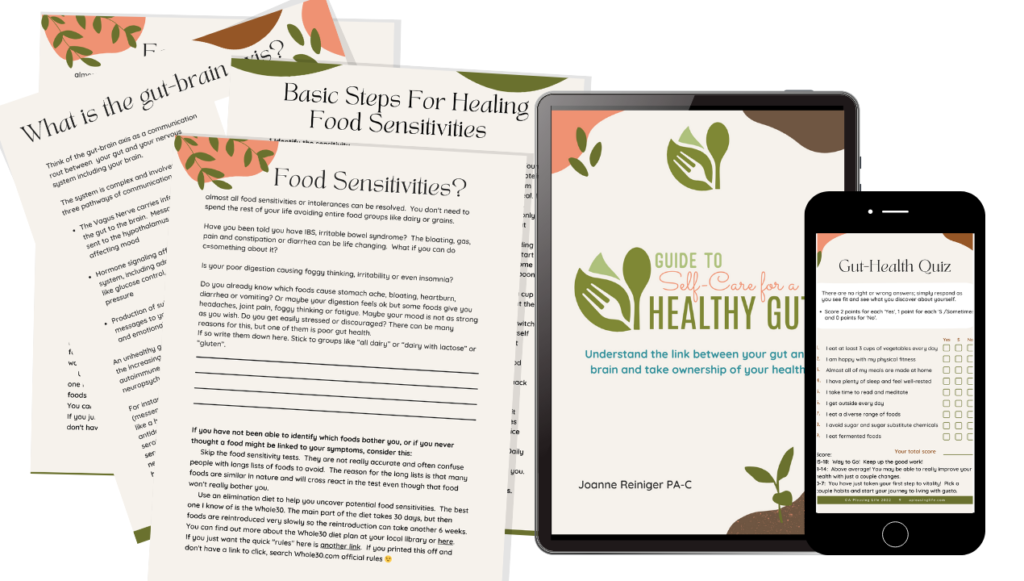
Want to go deeper on gut health and what it means for your whole body? My Guide to Self-Care for a Healthy Gut is a great place to start. Just click the image to get more information.
Now, the Math
Have You Calculated The Real Cost Of Backyard Eggs?
A standard hen eats about ¼ lb of feed per day in good weather. It can easily double in cold weather. My flock of 40 animals — 39 hens plus Judas, who as established contributes enthusiasm but not eggs and eats rather more than the average bird — consumes roughly 10-11 lbs of feed per day under optimal, zero-waste conditions. I average about 20 eggs per day, or 1.67 dozen.
| Feed Brand | Cost/50 lbs | Feed Cost Per Dozen |
|---|---|---|
| Poulin Grain Organic | $32.25 | $3.87 in good weather |
| New Country Organics (corn & soy free) | ~$44.50 | $5.34 |
| Cluck & Co Organic | $45.98 | $5.52 |
But There Is More To Raising Chickens Than Just The Feed Costs
Every number in that table is feed cost only. It does not include housing, bedding, hay for winter foraging, peat moss and sand for the dust baths that keep my hens free of mites, the organic squash and pumpkins I feed for hen health, the herbs and garlic and red pepper I mix in for parasite control and cold weather resilience, chick costs, or a single minute of my labor.
Not all hens are created equal, and knowing your flock matters. My 13 sex links — a mix of black and red — are production powerhouses when young, capable of 250-300 eggs a year. But here’s what the hatchery catalogues don’t always emphasize: they tend to burn out by year two or three. My 10 true blue-egg Ameraucanas are more moderate layers at 150-200 eggs annually, but they lay longer and more consistently over their lifetime. My flock is a mix of ages and breeds deliberately — which means at any given time some hens are ramping up, some are at peak, and some are winding down gracefully. That is not inefficiency. That is a living flock.
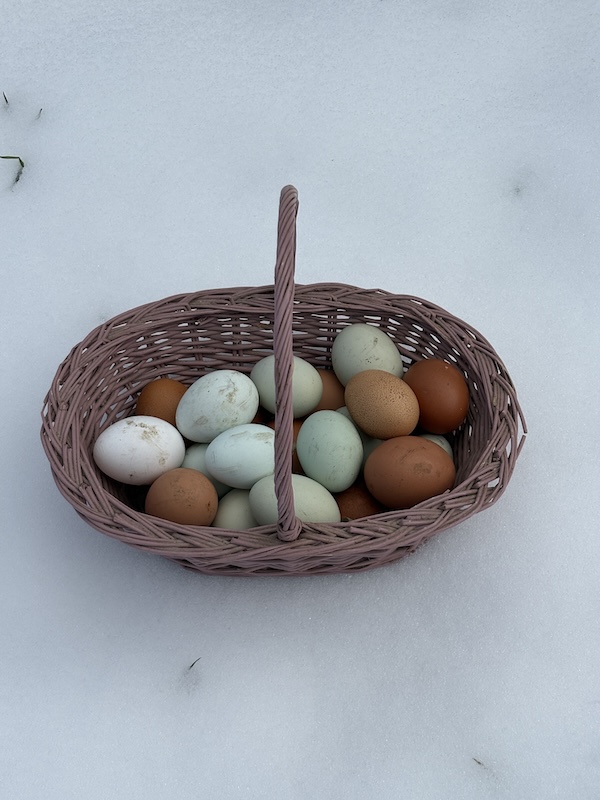
It also means your dozen eggs from me likely includes some of those beautiful blue Ameraucana eggs alongside large brown eggs from the sex links — something no grocery store carton will ever offer you.
And Maine winters change everything. When temperatures drop hard, feed consumption can easily double. On New Country Organics in a cold snap, my feed cost alone approaches $10 or more per dozen before anything else is counted.
My MOFGA-certified neighbors — using Poulin Grain, the same feed I just moved away from — sell their eggs to their CSA members at $7.25 a dozen. I have been charging $6.75 and genuinely believed I was pricing generously given my lack of formal certification. I still believe that.
So when someone tells me they’re selling organic, soy-free pastured eggs profitably at $5 a dozen, I have to say gently: the math doesn’t support it. Either the full costs aren’t being counted, the eggs aren’t quite what they’re being described as, or someone is quietly subsidizing the difference themselves — which is generous, but it isn’t a fair comparison.
Running Them Hard or Letting Them Live
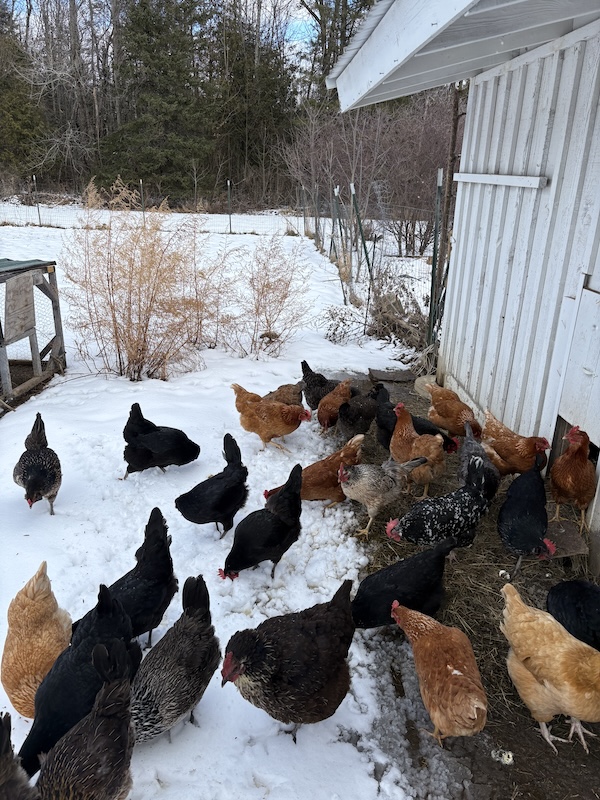
If you are thinking about getting chickens, this is the conversation nobody has with you at the feed store.
You can run chickens hard. Keep the lights on to push year-round laying. Buy sex links for maximum output. Cull at 18 months before production drops. Start a fresh batch. Repeat. On paper this is the most “efficient” system and it is how most small production operations work.
Or you can decide that the animals in your care deserve something closer to a natural life. My older hens lay less than they did at peak. They also eat less, free range contentedly, contribute to the health of my land, and will eventually become good soup. They are not a loss. They are part of a living system.
Proverbs 12:10 tells us that a righteous person cares for the needs of their animals. I’ve thought about that verse a lot in the context of my flock. I’m not here to tell anyone their farming practices make them wicked — that’s not what it means and it’s not my place. But I do think it’s worth asking, for those of us who keep animals, what “caring for their needs” looks like in practice. For me it means not engineering a shortened life of maximum output. That’s a personal conviction, not a judgment of anyone else.
There is no single right answer here, but there is an honest one: if you are going to keep chickens for natural, high-quality eggs, the costs of doing it well are real, and they do not disappear if you ignore them. The feed, the breeds, the philosophy of care — all of it shows up in the egg. And all of it shows up in the price.
On Priorities
I want to close with something more personal, because food pricing discussions have a way of feeling like judgment, and I genuinely don’t mean it that way.
I have made choices about money that look strange from the outside. There’s no 4-wheeler on this property, even though 22 acres in Maine could genuinely use one. I drive older vehicles. Vacations are not really in the budget. Those are not complaints — they are the result of deciding, a long time ago, that preventive health was the hill I was going to spend on. Real food is the foundation of that, and real food costs what it costs.
The women I serve through A Pleasing Life and in my medical practice often ask me how to stretch their health budget. My honest answer is always: start with your food. Every dollar you spend on genuinely nourishing food is working against inflammation, against hormone disruption, against gut dysfunction. It is the cheapest medicine most of us will ever have access to — even when it doesn’t feel cheap at the farmstand.
You are completely free to shop wherever fits your situation. We all make our trade-offs and there is no shame in any of them. I just want you to have the real information when you do.
Here is one of my first posts about the excitement of that first egg!
I would love to hear your experiences raising chickens. What feed do you use? How do you costs down while raising a great product?
References:
Vargas Galdos, D.M. (2009). Quantification of Soy Isoflavones in Commercial Eggs and Their Transfer from Poultry Feed into Eggs and Tissues. Ohio State University.
Link: https://etd.ohiolink.edu/acprod/odb_etd/ws/send_file/send?accession=osu1236706764&disposition=inline
When laying hen diets are enriched with omega-3 fatty acids via flaxseed, concentrations of ALA, EPA, and DHA in the yolk can reach 250 mg per 50g whole egg. PubMed
PubMed link: https://pubmed.ncbi.nlm.nih.gov/28108729/
A second study confirmed that omega-3-enriched egg consumption had a positive effect on serum lipid profile and blood pressure of patients with metabolic syndrome compared to normal eggs. PubMed
PubMed link: https://pubmed.ncbi.nlm.nih.gov/32566179/