
Hashimoto’s Thyroiditis:
What Your Doctor May Not Have Told You
If you’ve been diagnosed with Hashimoto’s thyroiditis — or suspect you might have it — you’ve probably been told it’s a “thyroid problem.” Take your medication and you’ll be fine.
But here’s what I wish more women understood: Hashimoto’s is not actually a thyroid problem. It’s an immune system problem that happens to target your thyroid.
This distinction matters. A lot.
Taking thyroid medication addresses the hormone deficiency, but it doesn’t stop the autoimmune attack. It’s like bailing water out of a leaky boat without ever patching the hole. To truly feel better, we need to understand what’s triggering your immune system in the first place.
The Three Stages of Hashimoto’s Thyroiditis
Autoimmune conditions don’t appear overnight. They develop through three stages, and research shows that autoantibodies can be present for an average of seven years before your labs look abnormal. And sometimes it’s a decade or two.
Stage 1: Silent Autoimmunity. Antibodies are present in your blood, but you feel fine. Your TSH looks normal. Only antibody testing would catch it here.
Stage 2: Autoimmune Reactivity. This is where so many women get stuck. Your thyroid tissue is being attacked and inflamed, but not enough damage has been done to show up on standard labs. Your TSH is “normal” — but you feel awful. Fatigue, brain fog, weight that won’t budge, problems with your menstrual cycle and fertility, feeling cold all the time. You have mood swings that defy control. You’re not sick enough for a diagnosis, but you’re definitely suffering.
Stage 3: Autoimmune Disease. Now enough tissue destruction has occurred that your TSH is elevated and your thyroid hormones are low. You “officially” have hypothyroidism. Thyroid replacement is typically necessary at this stage.
Here’s why this matters: If you have Hashimoto’s antibodies (TPO or thyroglobulin antibodies), you have an autoimmune process happening — regardless of what your TSH says. The goal is to slow or stop the progression, not just wait until enough damage has been done to require medication.
It’s All Connected
How Hashimoto’s Thyroiditis Affects Your Whole Body
One of the most frustrating things about Hashimoto’s is how it creates vicious cycles throughout your body. This is why simply taking supplements — or even thyroid medication — often isn’t enough.
Your gut and thyroid talk to each other. Thyroid hormones affect gut motility, digestive enzyme release, and your microbiome diversity. When thyroid function is low, digestion suffers. Poor digestion affects how thyroid hormones are metabolized. Conditions like SIBO, H. pylori, and dysbiosis all play a role in keeping this cycle going.
Blood sugar swings can trigger flares. Hashimoto’s affects how your body handles glucose. Skipping meals, eating high-sugar foods, or going too long without eating can trigger a stress hormone surge that activates inflammatory pathways. Stable blood sugar = calmer immune system.
Your brain is affected too. TPO antibodies can cross-react with brain tissue, particularly the cerebellum. This helps explain why so many Hashimoto’s patients experience fatigue, brain fog, depression, and difficulty concentrating — even when their thyroid labs look “normal.”
The Hashimoto’s Trigger That Surprises Everyone
When I tell patients about dietary triggers for Hashimoto’s, there’s one that always gets a reaction: iodine.
“But isn’t iodine good for the thyroid?”
In Hashimoto’s, excess iodine actually fuels the autoimmune fire. Research shows that iodine restriction alone can normalize thyroid function in up to 78% of Hashimoto’s patients within three months. Even small amounts of supplementary iodine — the amount in a teaspoon of iodized salt — can trigger thyroid dysfunction in those who are predisposed.
Check your supplements. Check your multivitamin. Many of them contain iodine you don’t need and may be making things worse.

You’re Not Crazy
If you’ve spent years being told your symptoms are “just stress” or “normal for your age” — they’re not. Your body is asking for attention.
Many women with Hashimoto’s swing between feeling sluggish (hypothyroid) and feeling wired (hyperthyroid) — sometimes within the same week. When your immune system attacks your thyroid, it can release stored hormones into your bloodstream, making you feel hot, anxious, and unable to sleep. Then you crash into exhaustion. You might even feel feverish, but your temperature is normal.
This is real. Your symptoms are real. And there is a path forward.
Want to Go Deeper?
Understanding what’s happening is the first step. But untangling your Hashimoto’s web requires tracking your own patterns — identifying your personal triggers and watching how your body responds.
I’ve created a comprehensive guide that walks you through the complete picture: all the interconnected “webs,” the full list of triggers with actionable steps, supplement guidance backed by research, a weekly symptom tracker, and a food/trigger journal to help you connect the dots.
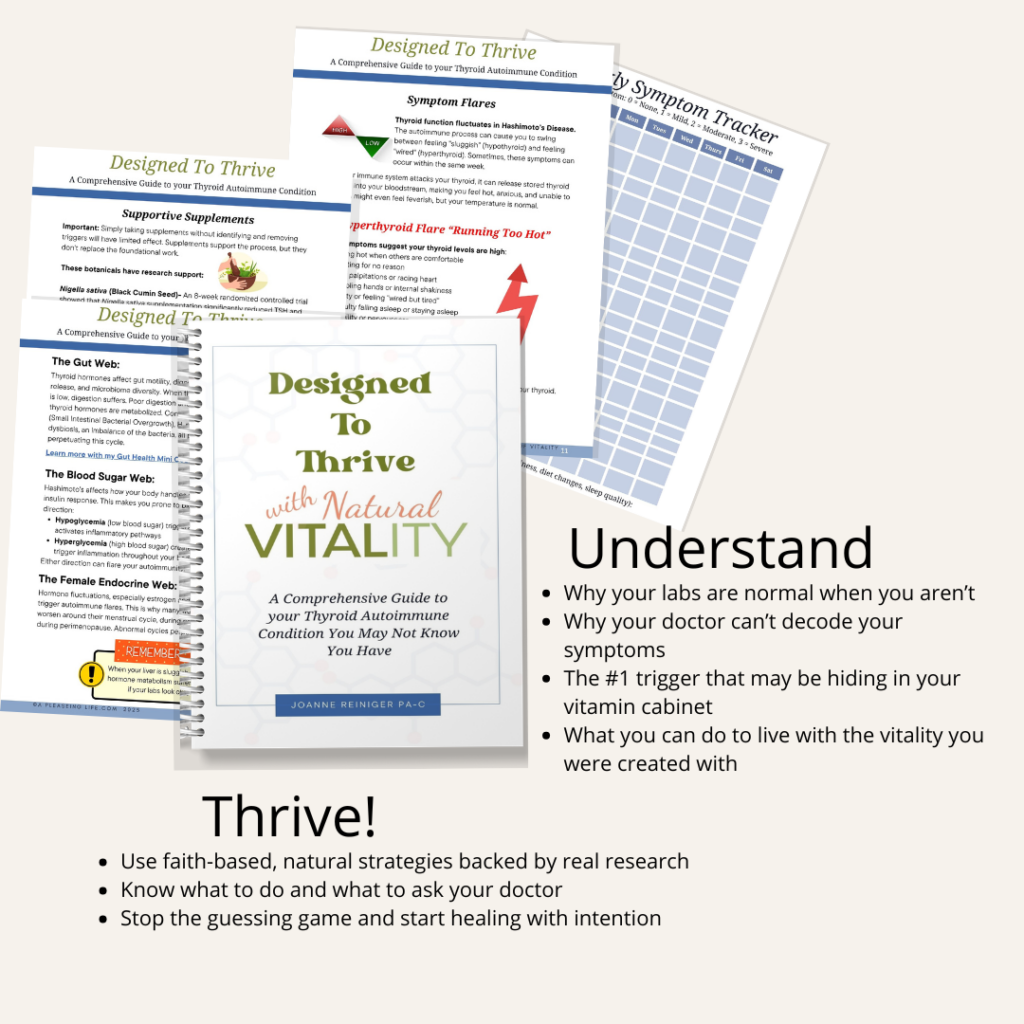
Because you deserve to feel well. And you don’t have to figure this out alone.
References
- Ma WT, Chang C, Gershwin ME, Lian ZX. Development of autoantibodies precedes clinical manifestations of autoimmune diseases: A comprehensive review. J Autoimmun. 2017;83:95-112.
- Yoon SJ, Choi SR, Kim DM, et al. The effect of iodine restriction on thyroid function in patients with hypothyroidism due to Hashimoto’s thyroiditis. Yonsei Med J. 2003;44(2):227-235.
- Reinhardt W, Luster M, Rudorff KH, et al. Effect of small doses of iodine on thyroid function in patients with Hashimoto’s thyroiditis. Eur J Endocrinol. 1998;139(1):23-28.